
I Wish Life Came With a Status Window
What Sung Jin Woo, Benjamin Franklin and your Duolingo streak have in common!?

Somewhere on Reddit, someone asked a question I haven’t been able to shake.
What if I could build Solo Leveling in real life?
And then they actually went and did it.
They built a whole system around themselves. Water intake, video games, habits, goals, the works. Not because they wanted to go fight monsters in a dungeon, but because they were stuck in a loop a lot of us know too well: get motivated, start ten habits and three productivity hacks on the same Monday, burn out by Thursday, feel worse than when you started, repeat next month.
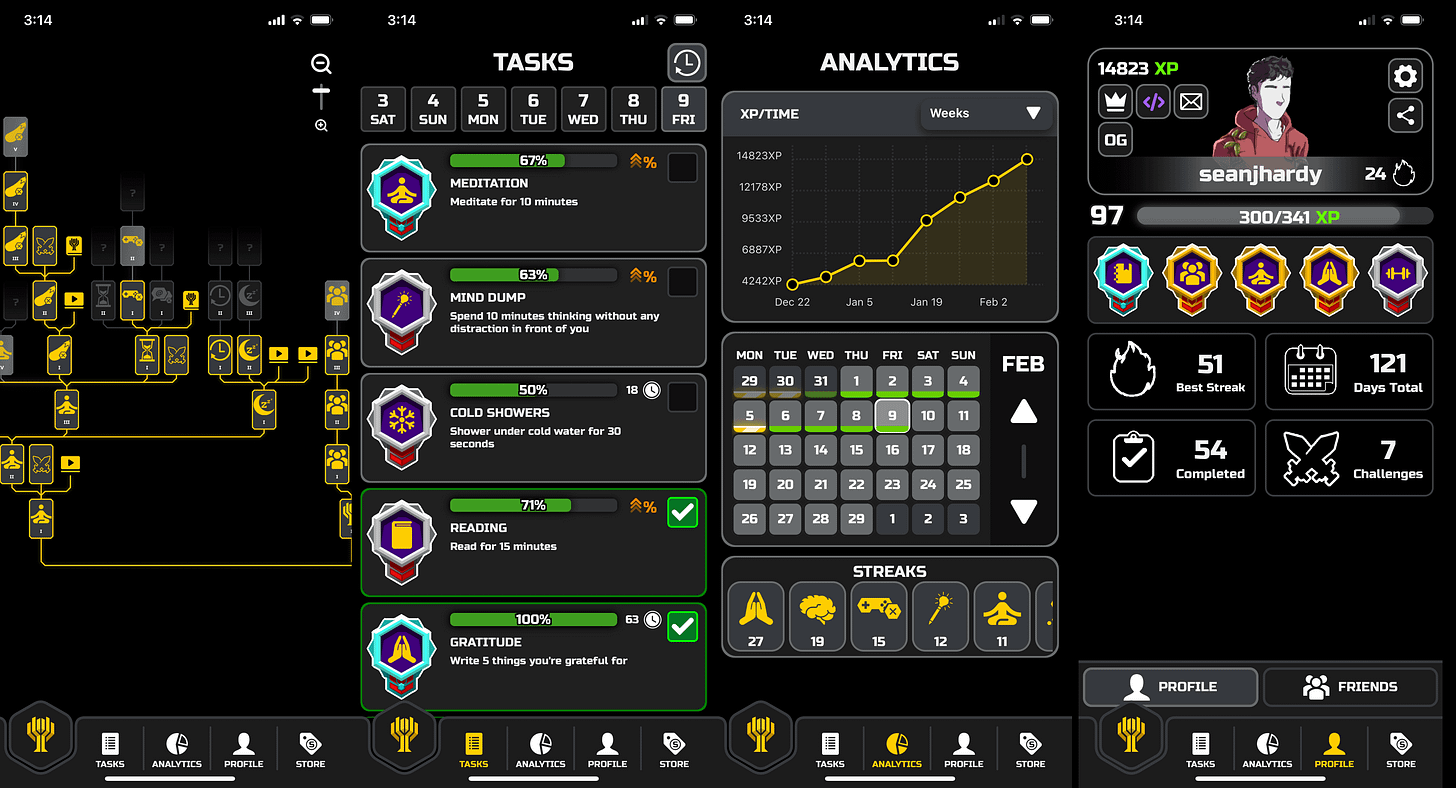
So instead of trying to find more motivation, they gave themselves a System.
I went down the rabbit hole after reading that, and turns out he isn’t alone. Not even close. There are Solo Leveling systems for fitness, for studying, for building habits, for “becoming a better person” in whatever way that means to you. There are entire apps and websites that take your actual life and hand it back to you as XP, quests, levels and daily missions.
Which sounds a little silly said out loud. Grown adults awarding themselves +5 Discipline for drinking water.
But stay with me here, because once you look at why Solo Leveling works in the first place, it stops being silly pretty fast.
It was never really about becoming absurdly powerful.
It’s about knowing exactly what to do next, and being able to see yourself getting better at it.
from the weakest hunter to the strongest
Quick recap for anyone who hasn’t watched it.
Sung Jin Woo starts at the very bottom. E-rank hunter, in a world where hunters walk into dungeons and fight monsters, and he is famously, almost comically weak.
So weak that other hunters don’t see him as competition. His reputation gets kind of ironic. If Jin Woo is around, people feel safer, and not because he’ll protect them. Everyone just knows he isn’t going anywhere that’ll get them killed. He’s basically a difficulty setting.
His body is fragile, his abilities are limited, and he comes out of every dungeon injured. And he keeps going back. (Well money does makes you do all kinds of odd jobs, but that’s not the point here.)
He doesn’t wait until he’s strong enough to start. He starts while he’s still weak.
Then comes the bit that actually kicks off his story. He gets betrayed by the people he went into a dungeon with and ends up face to face with dying. He passes a test called “Courage of the Weak.”
And then he gets the System.
And everything changes.
the System doesn’t do the work for him
This is the part I think most people skip past.
The System doesn’t make Jin Woo strong. It shows him how to get strong.
Daily quests. Stats. Abilities laid out in front of him. Rewards when he does the work, very clear consequences when he doesn’t. One loop, running over and over:
Do the work → gain experience → improve → level up.
He still has to run. Still has to fight, train, get hurt, make his own calls. Nobody handed him a cheat sheet. The System doesn’t remove the effort, it just makes the effort visible.
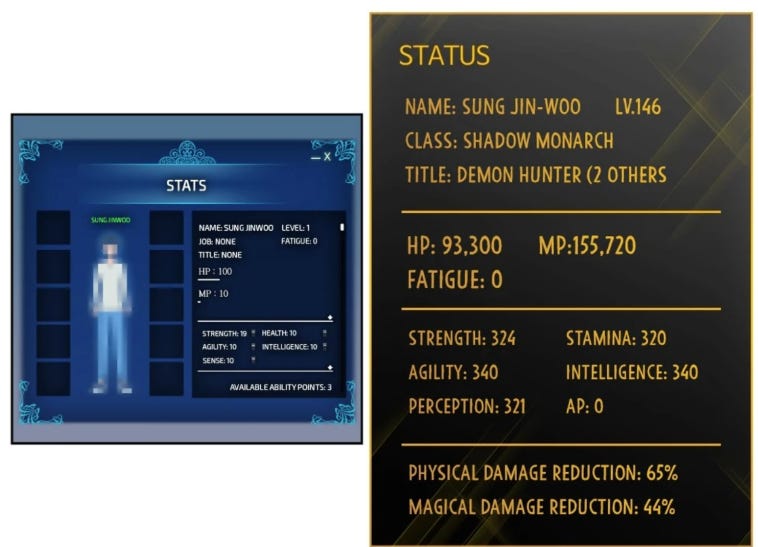
And that’s where a fantasy about dungeons starts getting suspiciously relevant to a Tuesday afternoon.
Because we don’t get a blue screen floating in front of our face going:
[Daily Quest] Study for 45 minutes.
[Reward] +10 Intelligence.
[Achievement Unlocked] Survived another terrible Monday.
Which is, honestly, tragic.
But we can build versions of it. And plenty of people already have.
we’ve been building Systems this whole time
Here’s the funny bit. The idea was never fictional. Look around for a second.
Duolingo. GitHub. Strava. Every habit tracker sitting on your phone right now. All of them doing the same job: showing you where you started and where you’ve reached. Long before a blue window showed up in an anime.
You still do the work. The system just changes what the work feels like.
Instead of “I’ve been learning for three months and I still don’t know anything,” you get to see 47 lessons done.
Instead of “I’m terrible at running,” you see your 5K time down by two minutes.
Instead of “I never get anything done,” you see 18 of your last 20 planned sessions, completed.
Same work. Same you. Completely different story running in your head about it.
And that matters way more than it sounds like it should.
the psychology bit (I promise it’s short)
Wanting to get better isn’t new, and neither is studying it. People have been researching versions of this for decades, so this isn’t just a neat storytelling trick.
One of the most repeated, most boring findings: goals work better when they’re specific, a little hard, and come with feedback.
Then I fell into research on progress monitoring. There’s a meta-analysis by Benjamin Harkin and colleagues that looked at 138 studies and nearly 20,000 people, and the finding is basically this. People who regularly track their progress are more likely to actually reach their goals. And the effect gets stronger when that progress is written down somewhere you can look at.
Total school vibes. Report cards were doing this to us the whole time.
That’s when Jin Woo’s little screen stopped feeling fictional to me.
The Status Window was never really a “do this, do that, become stronger” window. It took something completely invisible, progress, and turned it into something he could look at. Proof that the effort was going somewhere.
Which made me think that’s probably the whole reason leveling up feels so good. You’re not sitting there hoping you’re better. You can see that something changed.
Knowing exactly where you are makes the next level feel real.
real life has its own Sung Jin Woos
Take Bryan Johnson.
Whatever you think of him, and people think plenty, the man measures nearly everything happening in his own body and then uses those numbers to decide what to change next.
The interesting part isn’t whether you should copy him. You shouldn’t.
The interesting part is the loop sitting underneath all of it:
Observe yourself → measure something → change something → observe again.
That’s a feedback loop. And it’s much, much older than smartphones.
Look at Benjamin Franklin.

18th century, no apps, no wearables, no streak counters. He picked thirteen virtues he wanted to build and made himself a chart to track them. He also bookended his day with two questions. “What good shall I do this day?” in the morning, and “What good have I done today?” at night.
Centuries before anyone said the word gamification, this man was quietly maintaining a character sheet. (foreshadowing…?)
Once you notice the pattern you start seeing it everywhere. Athletes and their performance data. Companies and their KPIs. Students and grades. (Corporate folks and their timesheets.)
All of it doing the same job, answering a question our brains are genuinely bad at answering on their own. Am I actually getting better?
so why is this still so hard
Here’s where I got stuck.
If we already know that specific goals, feedback, progress tracking and a decent plan help people act, why is it still so hard to build a system that works for one particular person?
The answer turned out to be simpler than I expected. A fish can’t climb a tree, and a monkey isn’t winning any underwater races.
Your System can’t be mine.
Different starting point. Different strengths, different weak spots, different schedule, different goals, and very different reasons for wanting those goals in the first place.
A generic checklist can tell everybody to work harder. A real system should be able to tell you what “working harder” actually means for you, today.
And I think that’s the real lesson buried inside Solo Leveling.
Jin Woo didn’t get powerful because somebody handed him a universal formula for success. He got powerful because the System was built around him. It knew his level, it knew what he was missing, it gave him the next challenge, it showed him the progress. And then he went and did the work.
so what would yours look like
There’s no blue window showing up tomorrow morning, and no mysterious voice announcing [Daily Quest has arrived.] Nothing is going to notify you that you’ve finally become the person you wanted to be.
But maybe we don’t need the magic version. Maybe the real-world one is much simpler.
A goal → a plan → a way to measure it → a feedback loop → a bit of accountability → and a system built around the person actually trying to change.
Because leveling up was never about waking up as a different person overnight. It’s about making Level 1 visible enough that you start believing Level 2 is possible.
So, what would your System look like? And if you woke up with one tomorrow, what’s the first quest you’d want it to give you?
Maybe the future of getting better isn’t another motivational speech telling us to try harder. Maybe it’s better systems, ones that can tell us where we are, where we’re going, and what to do next.
And that’s exactly where technology, learning and human potential start getting interesting.