
Who Told the Ants?
...on ants, bees, bullet trains, and the rules nobody actually wrote
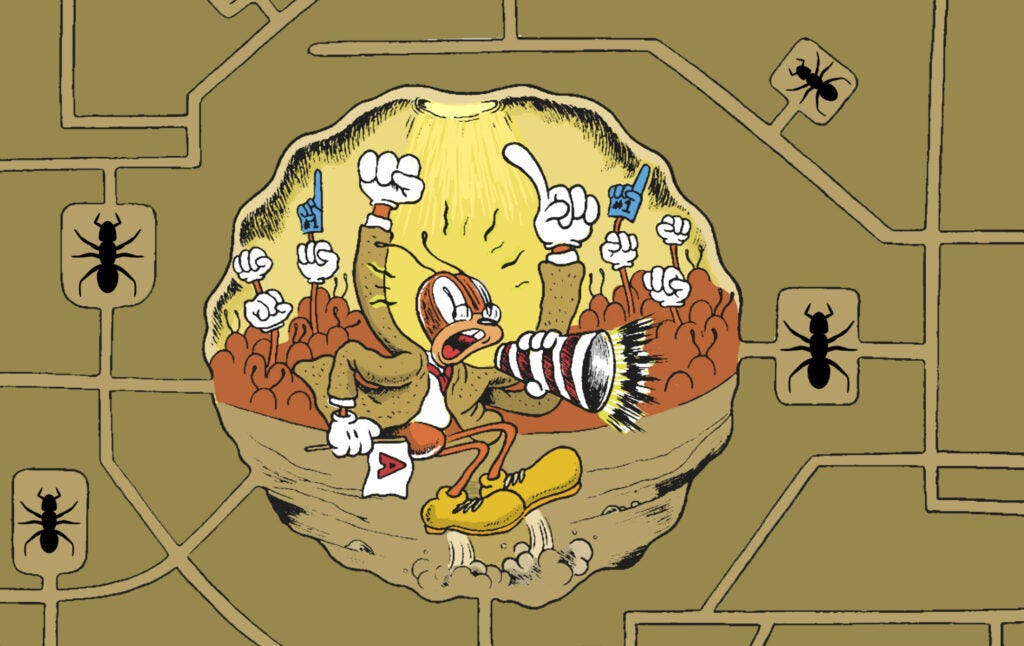
I was watching a video the other day and I can’t stop thinking about it.
Some researchers found a leaf cutter ant colony, poured tons of concrete into it (as one does), let it set, and then dug the whole thing out. What came up looked like a city. Highways. Side roads. Garden chambers. Garbage rooms. Air vents.
And my first thought was, okay, who designed this?
Turns out, nobody. There’s no architect ant. No manager ant. No tiny ant standing on a rock going “guys, we need a strategy.” Every ant is just following a few small rules: follow this smell, drop the dirt here, don’t go there. Put a few million of them together and you get infrastructure.
There’s a word for this, apparently: emergence. Simple things following simple rules and accidentally building something far bigger than any of them could plan.
I thought that was a fun ant fact. Then I started seeing it everywhere, and it stopped being about ants.
So I went down a rabbit hole
First stop was Japan, because of course it was.
You guys know how Japan has this reputation for order? Neat queues, silent trains, streets you could eat off. I always assumed someone was enforcing it. But then I remember that clip from the 2018 World Cup, where Japan lost to Belgium in the last seconds of the match after being 2-0 up. Absolutely heartbreaking. And what does the team do? Cleans the locker room. Spotless. Leaves a little thank-you note in Russian. Meanwhile the fans are in the stands picking up trash with bags they brought from home.

Nobody told them to. Nobody organized it. It’s just a habit that enough people repeated for long enough that it became the way. That’s the ant colony again, just with better manners.
Which made me look at my own kitchen, slightly suspiciously.
The sugar is next to the tea leaves. It’s always been next to the tea leaves. I never decided that. My mother did it, and I’m fairly sure her mother did too. I don’t think about how to brush my teeth, either. The pattern just runs.
So who writes these supposedly unsaid rules? Mostly nobody. Someone does a thing, someone else copies it, some other person tweaks it, and a few generations later it’s just “normal.” We’re not living in the matrix. But we might be living in one our grandmothers built.
And then I noticed humans have been doing this forever
Before calendars, people had the sky. And the ancient Egyptians had a very specific problem: the Nile flooded every year, and if you got the timing wrong, you lost your harvest.
So they watched. And someone noticed that a bright star, Sirius, would disappear for weeks and then pop back up on the horizon just before sunrise. And right around then, the river would rise.
They had no idea why. They didn’t know about orbits, or about rain falling in mountains a very long way away. Didn’t matter. The star showed up, the water showed up, and they built a whole calendar on that coincidence that wasn’t really a coincidence.
Noticing came first. Understanding came a few thousand years later.
Then things got suspiciously mathematical
Bees, for example.
Around 1,700 years ago, a Greek mathematician named Pappus looked at a honeycomb and basically said, “these bees know something.” His hunch: hexagons hold the most honey while using the least wax. Mathematicians then spent centuries arguing about whether he was right. It was finally proven in 1999.
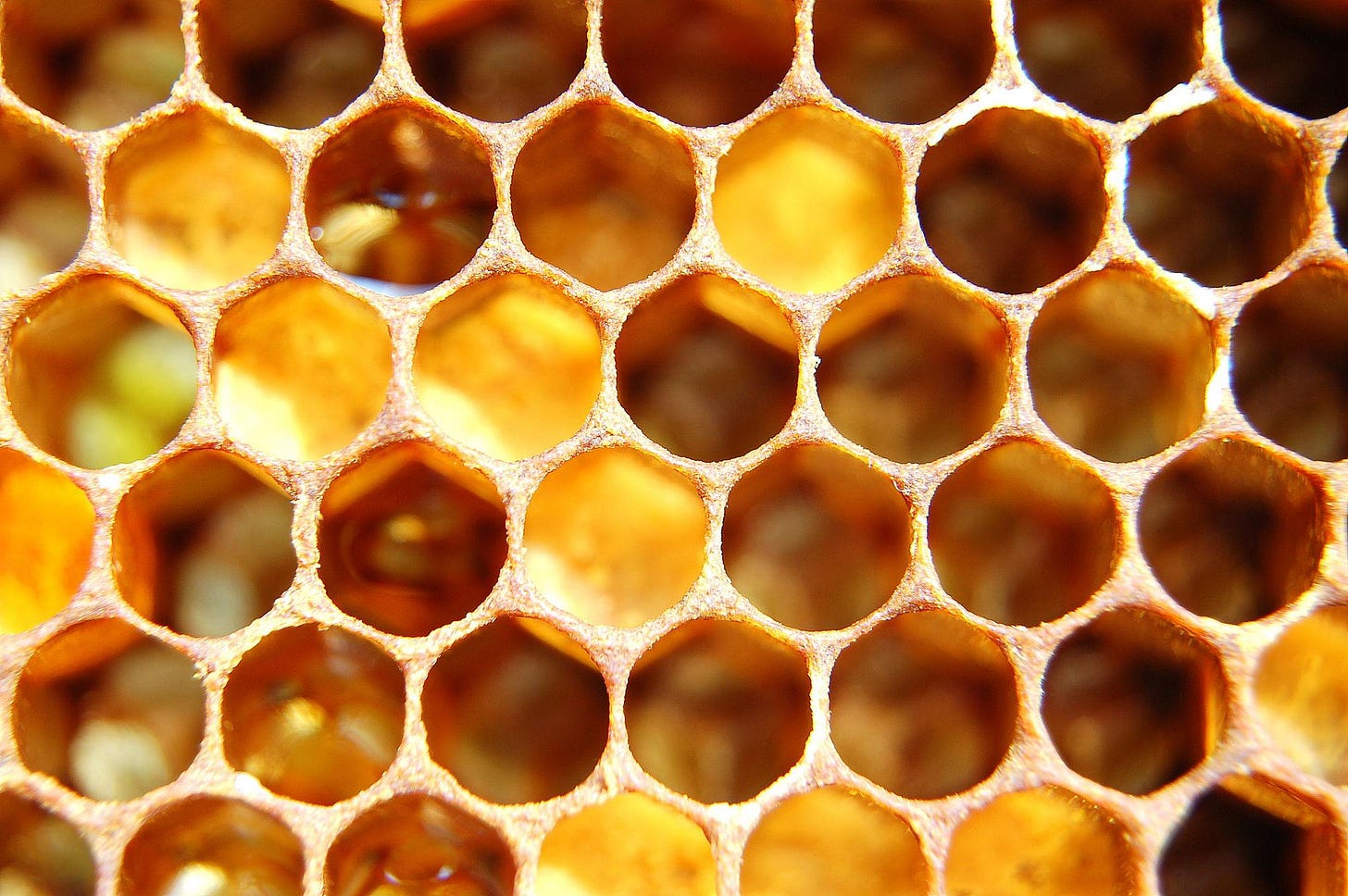
The bees, meanwhile, never showed their working. Some researchers think they just build roundish cells and the warm, soft wax gets pulled into hexagons on its own. So the bees did the math without doing any math. I respect that.
And it’s not just bees. Snowflakes are symmetrical. Shells spiral. Coastlines look the same when you zoom in. None of these things woke up and decided to be aesthetic.
Which left me with a question I still don’t have a clean answer to: is math actually in nature, or are we just really, really good at finding it? Probably both.
But the thing that got me is that math doesn’t just describe what we can see. Sometimes it helps us see what we can’t.
Like sound, which apparently has a shape
In the 1780s, a German scientist named Ernst Chladni had a very specific hobby. He’d sprinkle sand on a metal plate and scrape a violin bow along the edge. The sand would jump off the shaking bits and settle on the still bits, and suddenly there’d be these gorgeous geometric patterns sitting on the plate.
He took it on tour. Across Europe. With the plate. And at some point he showed it to Napoleon, who got so into it that he funded a prize for anyone who could explain the mathematics behind it.
Most mathematicians looked at it and quietly backed away. The person who eventually won was Sophie Germain, a mostly self-taught mathematician who had once written to other mathematicians under a man’s name just so they’d take her seriously. She tried three times. She won.
You can’t see a sound wave. But you can see what it leaves behind. And half of science, it turns out, is just finding clever ways to make invisible things visible.
Well humans aren’t the only ones good at finding solutions.
…sometimes nature already has the answer
Japan again, sorry. It keeps happening.
The Shinkansen had an embarrassing problem. Every time it zoomed into a tunnel, it squashed the air in front of it, and when it came out the other end, there was a loud boom. The neighbors were not fans.

The fix came from an engineer named Eiji Nakatsu, who, crucially, was a birdwatcher. He kept thinking about the kingfisher, a bird that dives from air into water with barely a splash. So the team gave the train a nose shaped like a kingfisher’s beak.
Quieter train. Faster train. Less electricity. All because one guy spent his weekends staring at birds.
There’s a name for that too: Biomimicry. Not copying nature, just borrowing a solution it’s already tested.
And sometimes we don’t even borrow. We just end up in the same place.
There’s a bird in Argentina called the Rufous Hornero that builds its nest out of mud and straw in the shape of an old clay oven. Its name literally comes from the Spanish word for oven. It’s warmer and steadier inside than outside.
And in Kutch, people have been building round mud houses called Bhungas for generations, thick-walled and cool inside, built to survive a brutal climate.

I really doubt anyone in Kutch watched a Hornero and went, “interesting, I shall now invent architecture.” They had a problem, tried things, kept what worked, and passed it on. Science came along much later to explain why it works.
Okay, so here’s what I think is going on
Somewhere around the bird nests, I realized I’d been reading the same story over and over.
Ants, bees, stars, sand, trains, mud houses, my kitchen shelf. Completely different things. Same shape underneath:
Someone notices something → realizes it’s not random → tries to describe it → tests it → uses it → it becomes a system.
That’s it. That’s how science works, how engineering works, how cultures work, and honestly how most of us get through a Tuesday.
A lot of what we call knowledge might just be patterns that survived enough people noticing them.
Which makes me wonder about the ones we haven’t figured out
“Red sky at night, shepherd’s delight.” I always filed that under grandma wisdom. But apparently it’s not nonsense. In a lot of the world, weather moves from west to east, so a red sunset often means clear skies are on their way. Shepherds worked that out centuries before anyone had a weather app.
Some old rules are just wrong. But some might be observations so old that the evidence got lost and only the rule survived.
Imagine how many patterns must’ve been sitting right in front of us, just waiting for someone to notice?
Maybe there’s another anthill out there. Another rhythm. Another weird little rule that someone will spot long before anyone can explain it.
It probably starts the same way it always has, with someone going: “Wait… why does that keep happening?”
Tell me, what’s a pattern you’ve noticed that made you wonder if there was something more to it?